

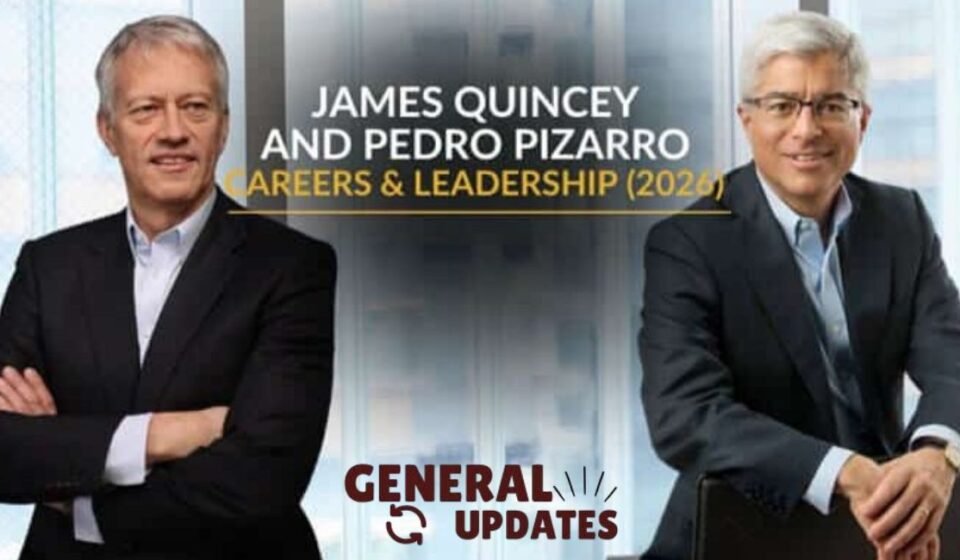

Pedro Pizarro and James Quincey stand out as two long-tenured corporate leaders who took similar routes to the top of very different industries. One guides a major electric utility through energy transition and grid challenges. The other spent nearly a decade reshaping a global beverage company before moving to an executive chairman role. Their stories show how consulting experience, deep operational knowledge, and steady progression inside one organization can prepare executives for complex leadership.
Readers will learn about their backgrounds, key career steps, leadership approaches, and the practical lessons their paths offer. The focus stays on verified public records and widely reported facts.
Early Paths: Education and Consulting Roots

James Quincey was born in London on January 8, 1965. He spent a few early years in the United States while his father taught biochemistry at Dartmouth College. The family later settled in Birmingham, England. Quincey earned a bachelor’s degree in electronic engineering from the University of Liverpool.
He started in management consulting at Bain & Company and later became a partner at The Kalchas Group, a strategy firm with roots in Bain and McKinsey. This work sharpened his skills in analysis and business strategy before he entered the corporate world.
Pedro J. Pizarro followed a science-focused route. He earned a bachelor’s degree in chemistry from Harvard University and a Ph.D. in chemistry from the California Institute of Technology. He held National Science Foundation and Department of Defense graduate fellowships. Raised partly in Puerto Rico, he later made Pasadena, California, his home.
Pizarro joined McKinsey & Company as a senior engagement manager in Los Angeles. He advised clients in energy, technology, engineering services, and banking on strategy, mergers, and operations. Both men gained structured problem-solving experience in consulting before joining their long-term employers in the 1990s.
Building Careers Inside One Company
Quincey joined The Coca-Cola Company in 1996 in Atlanta as director of learning strategy for the Latin America group. He moved into operational roles across the region. He served as president of the South Latin division starting in 2003 and later led the Mexico division from 2005 to 2008. There he oversaw the acquisition of Jugos del Valle.
He shifted to Europe as president of the Northwest Europe and Nordics business unit from 2008 to 2012, guiding the acquisition of Innocent Drinks. From 2013 to 2015 he led the broader Europe Group. In 2015 he became president and chief operating officer. He took over as CEO in May 2017 and became chairman of the board in 2019. He stepped down as CEO on March 31, 2026, and continues as executive chairman. Henrique Braun succeeded him as CEO.
Pizarro joined Edison International in 1999. He moved to Southern California Edison in 2001 and advanced through roles in strategy, business development, power procurement, transmission, and distribution. From 2011 to 2014 he served as president of Edison Mission Energy, an independent power producer subsidiary, until the sale of its main assets. He became president of Southern California Edison in 2014 and then president of Edison International in 2016. He was elected CEO in October 2016 and remains in that role while also serving on the company’s board.
Both leaders spent years learning the operational details of their companies before reaching the top. Quincey gained global experience across Latin America and Europe. Pizarro built expertise in the regulated utility sector, including generation, procurement, and grid operations.
Leadership Challenges and Focus Areas
As CEO of Coca-Cola, Quincey steered the company toward a broader total beverage portfolio. He supported growth in zero-sugar and low-calorie options, acquired brands such as Costa Coffee, Fairlife, and Bodyarmor, and emphasized marketing investment and efficiency. Shares rose significantly during his tenure as CEO, according to public reports. He also addressed packaging and sustainability topics in public forums.
Pizarro leads Edison International, parent of Southern California Edison, one of the largest U.S. electric utilities, and Trio, which provides energy advisory services. His priorities include grid modernization, wildfire risk reduction, customer affordability, reliability, and the shift toward cleaner energy. California’s energy landscape demands attention to load growth from electrification, cybersecurity, and resilience against extreme weather. He has served as chair of the Edison Electric Institute and co-chair of the Electricity Subsector Coordinating Council, roles that connect industry and government on infrastructure protection.
No public record shows a formal business partnership or direct professional collaboration between Pedro Pizarro and James Quincey. Their connection lies in the parallel structure of their careers: consulting foundations, long internal tenures, and leadership during periods of industry change.
Side-by-Side Snapshot
| Category | James Quincey | Pedro J. Pizarro |
|---|---|---|
| Current role | Executive chairman, The Coca-Cola Company | President and CEO, Edison International |
| Industry | Consumer beverages | Electric utilities and energy services |
| Joined main company | 1996 | 1999 |
| Became CEO | May 2017 | October 2016 |
| Consulting background | Partner, The Kalchas Group | Senior engagement manager, McKinsey |
| Education | Electronic engineering, University of Liverpool | Chemistry (Harvard AB, Caltech PhD) |
This comparison highlights shared patterns without forcing artificial links. Both men advanced by mastering operations inside complex organizations rather than jumping between companies.
Lessons from Their Approaches
Several practical takeaways emerge from their records. First, deep company knowledge matters. Quincey and Pizarro spent roughly two decades inside their organizations before becoming CEOs. That tenure gave them institutional memory and credibility with employees, boards, and external partners.
Second, consulting experience can provide a useful foundation. Both learned structured problem-solving and client management early on. Those skills translated into strategy roles and later into operational leadership.
Third, industry context shapes priorities. Quincey operated in a competitive consumer market that rewards brand innovation and portfolio shifts. Pizarro works in a heavily regulated utility environment where safety, reliability, affordability, and regulatory relationships carry heavy weight. Leaders must adapt their style to the sector’s constraints and opportunities.
Fourth, external board and industry roles expand influence. Quincey serves on the board of Pfizer. Pizarro serves on the 3M board, chairs key industry groups, and acts as a Caltech trustee. These positions broaden perspective and strengthen networks.
Public sources do not provide precise personal net-worth figures that are consistently verified across independent outlets. Compensation details appear in company proxy statements and can vary year to year. Readers seeking financial specifics should consult the latest SEC filings for each company.
Why These Careers Matter Now

Corporate leadership continues to face pressure from technological change, regulatory shifts, climate concerns, and evolving customer expectations. Quincey’s work at Coca-Cola illustrates how a legacy brand can expand beyond its core product. Pizarro’s role at Edison International shows the demands of modernizing essential infrastructure while managing public accountability.
Studying Pedro Pizarro and James Quincey together offers a clear view of two successful internal-advancement models. One operated globally in consumer goods. The other focused regionally in a critical regulated industry. Both demonstrate that consistent operational experience, combined with strategic thinking, remains a reliable path to senior leadership.
Their records also underline the value of preparation over flash. Neither career featured rapid external jumps or sudden celebrity. Instead, steady progression, functional expertise, and adaptation to industry realities defined their rises.
For professionals considering long-term careers inside large organizations, these examples provide concrete reference points. They show how technical or analytical training can lead into general management, and how consulting skills can support later operational responsibility. The differences in industry context also remind readers that leadership success looks different across sectors.
Pedro Pizarro and James Quincey continue to shape their organizations in distinct ways. One as executive chairman guiding a global beverage company. The other as active CEO of a major energy firm navigating California’s complex utility environment. Their parallel stories remain useful case studies in sustained corporate leadership.
Also read: Wayne Gretzky and Larry Culp: Careers Compared
FAQs
What companies do Pedro Pizarro and James Quincey lead?
Pedro Pizarro is president and CEO of Edison International. James Quincey is executive chairman of The Coca-Cola Company after serving as CEO.
Did Pedro Pizarro and James Quincey work together?
No public record shows a formal partnership, joint venture, or direct professional collaboration between them.
What education backgrounds do they have?
James Quincey earned a degree in electronic engineering from the University of Liverpool. Pedro Pizarro holds a chemistry degree from Harvard and a Ph.D. from Caltech.
When did each become CEO?
Pizarro became CEO of Edison International in October 2016. Quincey became CEO of Coca-Cola in May 2017.
What consulting firms did they work for earlier?
Quincey was a partner at The Kalchas Group. Pizarro was a senior engagement manager at McKinsey & Company.



[…] Pedro Pizarro and James Quincey: Leadership Paths Compared […]