

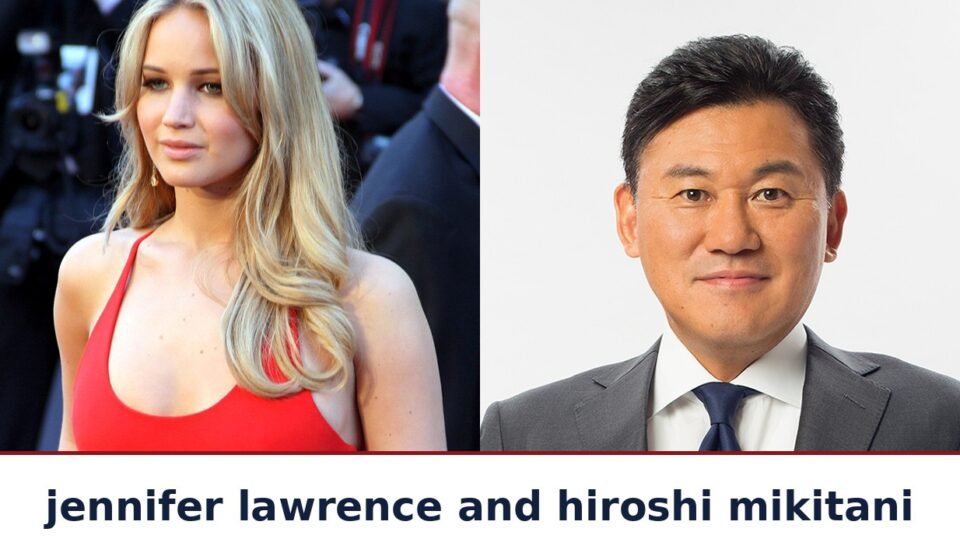
jennifer lawrence and hiroshi mikitani: The Actress and the Rakuten Founder, Two Lives Without a Shared Story

Introduction
jennifer lawrence and hiroshi mikitani are two names that rarely appear in the same sentence, and that is exactly why readers search for them together. One is an American actress whose face became familiar to audiences around the world through a string of major films, while the other is a Japanese businessman who built one of the largest internet companies in Asia from a small office with a handful of staff. Their worlds look nothing alike, one shaped by cameras, scripts and red carpets, the other shaped by balance sheets, acquisitions and mobile networks, yet both reached the top of their fields through a mix of timing, nerve and relentless work. This guide sets out their real stories side by side, explains what each of them actually achieved, and answers the question that sits behind the search itself, namely whether any real link joins the two names.
Readers who arrive at the pairing of jennifer lawrence and hiroshi mikitani usually want one of two things, either a clear biography of each person or an honest answer about a rumoured connection. Both needs are met here, and the honest answer comes first in spirit, because no verified professional or personal connection joins Lawrence and Mikitani in any public record found during research for this guide. No shared film, no shared company, no endorsement deal and no documented meeting ties them together, and any page that claims otherwise without a source should be read with care. What follows is therefore a double biography built only on facts that can be checked, with the unverified left clearly marked as unverified, so that readers leave with a true picture of two remarkable careers rather than an invented story about a partnership that never happened.
jennifer lawrence and hiroshi mikitani: The Early Years of Jennifer Lawrence
Jennifer Shrader Lawrence was born on August 15, 1990, in Louisville, Kentucky, where she grew up with two older brothers, Ben and Blaine, in a household far removed from film sets. Her mother, Karen, ran a children’s summer camp, and her father, Gary, worked in the construction business, so the young Lawrence spent her early years around camp activities, school plays and local theatre rather than auditions and agents. She took part in cheerleading, field hockey, softball and modeling as a child, yet none of those pursuits held her attention for long, and by the age of fourteen she had decided that acting was the path she wanted to follow. That decision took her with her mother to New York City, where a talent scout noticed her during a summer visit, and the cold reading she gave in that first encounter impressed agents enough for them to urge her to spend the summer working in the city.
The New York summer led to small commercial and modelling jobs, including a promotional spot for an MTV reality series, and the family soon moved to Los Angeles so that Lawrence could pursue acting full time. She left school two years early, finishing with strong grades, and began collecting television work, with guest spots on series such as Monk, Medium and Cold Case before landing a regular role. From 2007 to 2009 she played Lauren Pearson, the eldest daughter in the TBS comedy The Bill Engvall Show, a part that gave her steady screen experience and a Young Artist Award for her work on the series. Those early television years matter because they show a performer learning her craft in public, without drama school training, relying instead on observation, instinct and a willingness to take small parts seriously, a pattern that would define her later career as well.
jennifer lawrence and hiroshi mikitani: The Breakthrough Years of Jennifer Lawrence
Lawrence’s first major film breakthrough came with Winter’s Bone in 2010, an independent drama in which she played Ree Dolly, a seventeen-year-old in the Ozark Mountains who cares for her mentally ill mother and younger siblings while searching for her missing father. She travelled to the Ozarks a week before filming to live with the family on whom the story was based, and she prepared by learning to fight, chop wood and handle the practical skills the role demanded, an approach that gave the performance its grounded, unsentimental force. Critics praised the work, the film won the Grand Jury Prize at the Sundance Film Festival, and Lawrence received her first Academy Award nomination for Best Actress at the age of twenty, making her the second-youngest nominee in that category at the time. The role proved that she could carry a film on her own presence, and it remains the performance that serious film watchers cite when they explain why her later fame was earned rather than manufactured.
Only a year later, Lawrence stepped into large-scale franchise filmmaking as Raven Darkholme, also known as Mystique, in X-Men: First Class, a prequel that recast the mutant saga with a younger ensemble. The part asked for something very different from Ree Dolly, namely a shape-shifting character whose loyalties shift across the story, and Lawrence returned to the role in later entries including X-Men: Days of Future Past, X-Men: Apocalypse and X-Men: Dark Phoenix. Around the same period she appeared in smaller films such as The Beaver, Like Crazy, The Burning Plain and House at the End of the Street, keeping one foot in independent drama even as studio work grew. That balance, moving freely from a low-budget character study to a global franchise and back again, became a hallmark of her career, and it helped her avoid being fixed in the mind of audiences as only one kind of performer.
jennifer lawrence and hiroshi mikitani: The Hunger Games Years and the Oscar Win
The role that turned Lawrence into a global star arrived in March 2011, when she was offered the part of Katniss Everdeen in The Hunger Games, the film version of the first novel in Suzanne Collins’s young-adult trilogy. Lawrence was already a fan of the books, yet she took three days to accept the part because she understood how large the production would be and how much it could change her life, a hesitation that says a great deal about her attitude to fame. Preparation was physical and thorough, covering stunt work, archery, rock and tree climbing, combat, running, parkour, pilates and yoga, and the film opened on March 23, 2012, with a record-breaking opening weekend of 152.5 million dollars for a non-sequel film. Critics singled out her performance above all else, with reviewers noting that she anchored the whole film with gravity and presence, and the part made her, at that time, the highest-grossing action heroine in cinema history.
Lawrence returned as Katniss in The Hunger Games: Catching Fire and in the two Mockingjay films, completing a four-film run that carried the series from 2012 to 2015 and kept her at the centre of popular culture for four straight years. In the middle of that run came the performance that won her the Academy Award, her turn as Tiffany Maxwell in David O. Russell’s Silver Linings Playbook, released in 2012 opposite Bradley Cooper and Robert De Niro. She was only twenty-one when the film was shot and twenty-two when she won the Best Actress prize, making her the second-youngest winner of that award and the first person born in the 1990s to win an acting Oscar. The same director then cast her in American Hustle in 2013, where she played Rosalyn Rosenfeld and earned a Best Supporting Actress nomination, and in Joy in 2015, where she played entrepreneur Joy Mangano and earned another Best Actress nomination, a run of three nominations in four years that few performers of any age can match.
jennifer lawrence and hiroshi mikitani: The Later Career of Jennifer Lawrence
After the franchise years, Lawrence continued to mix large productions with riskier choices. She appeared in the science-fiction romance Passengers in 2016, the psychological drama mother! in 2017, the spy thriller Red Sparrow in 2018, and the closing chapter of her mutant saga, Dark Phoenix, in 2019, each part demanding a different register from the last. She also became the face of the fashion house Dior in 2012, a long-running association that kept her visible in the fashion world alongside her film work, and she founded the production company Excellent Cadaver with producing partner Justine Ciarrocchi, giving herself a route into shaping projects from the start rather than only accepting roles offered to her. Readers who follow celebrity life stories will recognise this phase as the point where a star stops being only a performer and starts building a longer career on her own terms.
The most recent phase of Lawrence’s career has leaned toward drama and producing, with Don’t Look Up in 2021, in which she played astronomer Kate Dibiasky opposite Leonardo DiCaprio, and Causeway in 2022, a quiet portrait of a soldier returning home that she also produced. She then turned to comedy with No Hard Feelings in 2023, and to intense literary drama with Die, My Love in 2025, directed by Lynne Ramsay and shown at the Cannes Film Festival. Away from the screen, she married art dealer Cooke Maroney in 2019, welcomed a son, Cy, in 2022, and a second child followed in 2025, milestones she has discussed only sparingly in public.
jennifer lawrence and hiroshi mikitani: The Early Life of Hiroshi Mikitani
Hiroshi Mikitani was born on March 11, 1965, in Kobe, in Hyogo Prefecture, Japan, into a family where learning and public service were taken seriously. His father, Ryoichi Mikitani, was an economist who became Japan’s first Fulbright Scholar to the United States and taught for two years at Yale University, during which the family lived in New Haven, Connecticut, from 1972 to 1974, so the young Mikitani spent part of his childhood in America before returning to Japan. His mother, Setsuko, was a Kobe University graduate who had attended elementary school in New York and later worked for a trading company, while his sister Ikuko became a physician and his brother Kenichi became a professor of biology at the University of Tokyo. That family background matters because it placed Mikitani close to both Japanese academic life and the wider world from an early age, and it helps explain the international outlook that later shaped his company.
Mikitani attended Hitotsubashi University in Tokyo, graduating in 1988 with a degree in commerce, and joined the Industrial Bank of Japan as an investment banker the same year. He left the bank for a period from 1991 to 1993 to earn an MBA at Harvard Business School, then returned to banking before the devastating Kobe earthquake of 1995 changed his direction. Mikitani has said that the destruction he saw in his home city made him want to help rebuild Japan’s economy rather than continue in finance, and he resigned from the bank to start his own consulting firm, Crimson Group. The same year, after the earthquake left the city unable to maintain its football club, he was asked to take over the running of Vissel Kobe, which he purchased through Crimson Group, an early sign of the hands-on, civic-minded approach that would mark his business life.
jennifer lawrence and hiroshi mikitani: The Founding of Rakuten
On February 7, 1997, Mikitani founded the e-commerce company MDM, Inc. with three co-founders and 250,000 dollars of their own money, and on May 1, 1997, the company launched its online marketplace, Rakuten Ichiba, in Japan. The marketplace began very small, with thirteen shops and six employees, and its founding idea was a hybrid of the models then emerging abroad, an online shopping mall where independent sellers could reach customers across the country rather than a single store selling its own stock. The company was renamed Rakuten, Inc. in 1999, and Mikitani took it public on the JASDAQ exchange in 2000, a fast rise from a six-person start-up to a listed company in only three years. The name Rakuten itself means optimism in Japanese, and that word captures the spirit of the venture, a wager that small merchants, given the right platform, could thrive online.
From 2010 onward, Mikitani pushed Rakuten beyond Japan, buying overseas companies including Buy.com in the United States, PriceMinister in France, the Canadian e-book service Kobo, the American cashback site Ebates and the messaging app Viber, while taking minority stakes in firms such as Pinterest and the ride-hailing company Lyft, where he joined the board. In March 2010 he also began the policy he calls Englishnization, making English the primary working language of Rakuten within two years, a move that outside observers dismissed at first but that later became the subject of a Harvard Business Review case study. Readers who follow business founder stories will see in this period the classic second act of a founder, moving from building a single product to building an ecosystem, with Rakuten growing to cover e-commerce, financial services, digital content and, in time, mobile communications.
jennifer lawrence and hiroshi mikitani: The Later Career of Hiroshi Mikitani
Mikitani’s later career shows the same breadth as his early years, moving across sport, culture, public life and new industries without leaving Rakuten’s centre. He rebuilt the Sendai stadium for the Tohoku Rakuten Golden Eagles, the expansion baseball team founded in 2005, and the team won the Japan Series in 2013, two years after the earthquake and tsunami that devastated the Tohoku region. In 2017 he partnered with his friend, the footballer Gerard Piqué, to co-found Kosmos Holding, an investment group focused on sport, media and entertainment, which later acquired the Davis Cup tennis property and the Spanish club FC Andorra. He has also chaired the Tokyo Philharmonic Orchestra since 2011, served as Representative Director of the Japan Association of New Economy, a body launched in June 2012 after he quit the Keidanren business federation in 2011 over its stance on nuclear power following the Fukushima disaster, and kept a seat on the board of Lyft.
Rakuten itself kept growing under his leadership into a group spanning more than seventy services, operating in more than thirty countries and regions and employing more than twenty-nine thousand people, with Rakuten Mobile becoming Japan’s newest mobile network operator and Rakuten Medical developing cell-targeting cancer research under his chairmanship. His honours include the Harvard Business School Alumni Achievement Award in 2012, the rank of Chevalier of the National Order of the Legion of Honour from France in 2014, and the Order of Merit of the Grand Duchy of Luxembourg in 2017, and in April 2024 he attended the White House state dinner held for Japan’s prime minister. In February 2022 he announced a personal donation of one billion yen to the Ukrainian government during the Russian invasion, a gesture that drew wide attention. He has been married to Haruko Mikitani since 1993, and the couple have two children, a private family life that contrasts with the very public scale of the company he runs.
jennifer lawrence and hiroshi mikitani: Facts at a Glance
| Point | Jennifer Lawrence | Hiroshi Mikitani |
|---|---|---|
| Born | August 15, 1990, Louisville, Kentucky, United States | March 11, 1965, Kobe, Hyogo, Japan |
| Known for | Acting, including the Academy Award for Best Actress | Founding and leading Rakuten Group |
| Signature work | Katniss Everdeen in The Hunger Games film series, Tiffany Maxwell in Silver Linings Playbook | Rakuten Ichiba, launched May 1, 1997, with thirteen shops and six employees |
| Education | Left school two years early in Louisville, no drama school training | Hitotsubashi University, commerce, 1988, and Harvard Business School MBA, 1993 |
| Family | Married Cooke Maroney in 2019, son Cy born in 2022, second child in 2025 | Married Haruko Mikitani in 1993, two children |
| Current role | Actress and producer through Excellent Cadaver | Representative Director, Chairman, President and CEO of Rakuten Group |
jennifer lawrence and hiroshi mikitani: Is There a Connection?
The direct answer is no, because no verified record shows a shared project, a business deal, an endorsement or a documented meeting linking jennifer lawrence and hiroshi mikitani, and readers should treat any page that claims such a link without naming a source as speculation rather than fact. Lawrence’s professional world is film production, studio releases and fashion campaigns, while Mikitani’s world is e-commerce platforms, financial services, telecom networks and sports ownership, and their paths run through different countries, industries and institutions. Lawrence has no known Rakuten endorsement, Rakuten has no known Lawrence campaign, and their names do not appear together in company filings, film credits or reputable news reports about either person. Pair searches of this kind usually reflect simple curiosity about two famous names rather than a hidden story, and in this case the curiosity is understandable, since both people dominate conversation in their own fields and both rose from modest starts to global prominence.
What the two careers do share is a pattern worth noting, even though it is a pattern of character rather than a connection of fact. Both began without the advantages that usually smooth a rise, Lawrence without drama school or industry family ties, Mikitani with a small sum of his own money and a handful of colleagues, and both kept control of their work as their fame grew, Lawrence by producing through her own company and Mikitani by staying at the head of Rakuten for nearly three decades. Both also widened their reach beyond their first success, Lawrence moving from franchise films into producing and independent drama, Mikitani moving from a single marketplace into finance, content, sport and mobile networks. Those parallels make the pairing interesting to read about, but they remain parallels, not proof of any meeting, deal or friendship, and this guide records them as such.
Conclusion
jennifer lawrence and hiroshi mikitani stand as two of the most successful figures of their generations, one an Oscar-winning actress who carried a global film series, the other the founder who turned a six-person marketplace into a worldwide group. No verified link joins them, and their shared story is one of parallel ambition rather than partnership, which makes each career worth knowing on its own merits.