

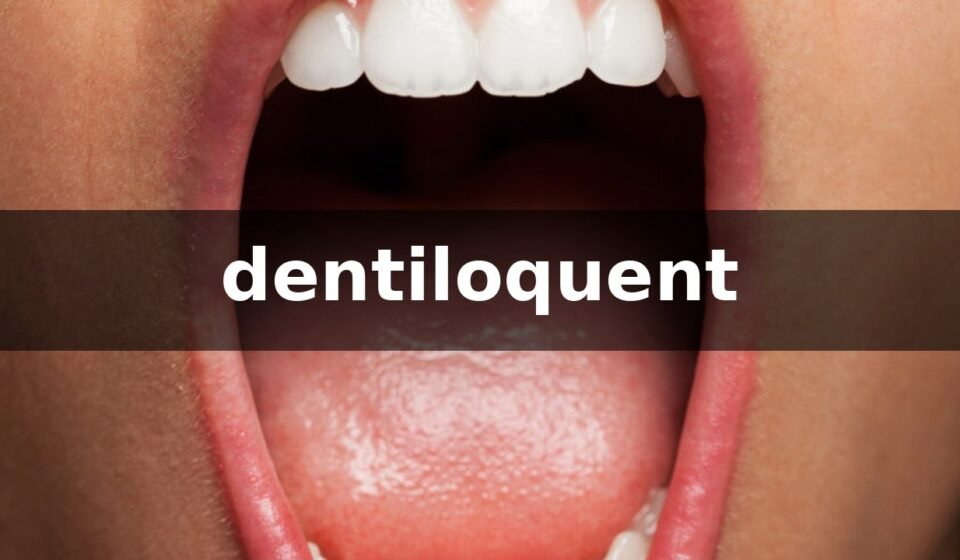
dentiloquent: The Rare Word for Speaking Through the Teeth, Its Latin Roots and Its Long History

Introduction
dentiloquent is a rare English word that most readers will never meet in ordinary reading, yet it has a clear meaning and a long history behind it. In plain terms, dentiloquent describes speech that comes through the teeth, or a person speaking in that manner, with the teeth held close or closed while the words are formed. It is an adjective, and it points to the physical manner of speaking rather than to the sense of the words being spoken. A dentiloquent reply can be calm, firm, angry, or polite, since the word says nothing on its own about feeling or tone, and it says nothing about whether the speaker is right or wrong.
This guide explains dentiloquent from the ground up, using only facts that can be checked in public dictionary sources and word histories. It covers what the word means, where it comes from, how long it has been recorded, how it differs from similar words, and how a careful writer can use it today without misleading readers. Where the evidence runs thin, this guide says so plainly, since a rare word deserves honest handling rather than a polished story built on guesses. Readers who came here looking for a dentiloquent meaning will find the answer in the first sections, and readers who came for a dentiloquent definition they can trust will find the dictionary record set out with its limits stated.
The sections that follow work in order, starting with the meaning itself, then the Latin roots, then the historical record, then the near neighbours in the same word family, then the plain science of how teeth shape speech sounds, and finally practical advice for using the word in writing. A facts table gathers the core points in one place, and a set of reader questions closes the main body before the conclusion. Examples given in this guide are marked as illustrative wherever no attested quotation was found, so that no reader mistakes a made-up illustration for a quotation from a book.
dentiloquent: What the Word Means
The core dentiloquent definition is simple and stable across the sources that record it. Dentiloquent means speaking through the teeth, and it describes either a person who speaks in that way or speech that is produced with the teeth together. The related noun dentiloquy carries the same idea in noun form, and older dictionaries define dentiloquy as the habit or practice of speaking through the teeth or with the teeth closed. The adjective and the noun therefore work as a pair, with dentiloquy naming the practice and dentiloquent describing a person, a voice, or an utterance that shows it.
It helps to be precise about what the word does not claim, since rare words often collect extra meanings that the record does not support. Dentiloquent does not mean whispering, mumbling, shouting, or speaking incorrectly, and it does not on its own mean that a speaker is angry, although a person who is angry may well speak through clenched teeth. The word points to mouth position and manner, not to volume, clarity, or feeling, so a writer who uses it should make sure the context supplies the feeling if feeling is part of the point. A sentence such as “she gave a dentiloquent reply” tells the reader how the reply was delivered, and any hint of anger or restraint must come from the surrounding sentences rather than from the word alone.
The word also does not describe a speech disorder, and this distinction matters for fair writing. A lisp or a stammer is a pattern of speech production with its own causes and its own terms, while dentiloquent describes a manner that any speaker can adopt for a moment, whether from habit, tension, effort, or choice. Exam and vocabulary sources that list dentiloquent among similar words keep this line clear, since they place speaking with a stammer or lisp under a different term, blesiloquent, rather than under dentiloquent. A careful writer therefore avoids using dentiloquent as a label for a person’s speech difficulty, and uses it only for the physical manner it actually names.
dentiloquent: The Latin Roots Behind the Word
The dentiloquent etymology is transparent once its two Latin parts are set side by side, and it explains the meaning with no mystery left over. The first part comes from the Latin word dens, whose stem form is dentis, meaning tooth, and the same stem gives English a whole family of tooth words, including dental, dentist, dentistry, denture, and indent. The second part comes from the Latin verb loqui, meaning to speak, and its speaking stem gives English the long -loquent family, including eloquent, loquacious, and grandiloquent. Put the two parts side by side and the sense falls out at once: tooth plus speaking gives speaking through the teeth.
The -loquent family is worth knowing, since it shows how English builds many words for manners of speaking from one Latin root. Eloquent describes fluent and forceful speech, loquacious describes talkative speech, grandiloquent describes speech that is grand and high-flown, melliloquent describes speech that is sweet or honeyed, breviloquent describes speech that is brief, and blandiloquent describes speech that flatters. Dentiloquent sits in the same family, but it differs from most of its relatives in one useful way, since most -loquent words judge the quality or style of speech, while dentiloquent judges only the physical manner, the position of the teeth while speaking. That narrow physical sense is what makes the word precise, and it is also what keeps it rare, since few situations call for a single word for that exact manner.
dentiloquent: A Word With a Long History
Dentiloquent is old as well as rare, and its historical record reaches back to the seventeenth century. An academic study of historical English vocabulary records dentiloquent in Thomas Blount’s Glossographia of 1656, a dictionary of hard and unusual words, where it was associated with speaking through the teeth. That early appearance matters, since it shows that the word was already being collected and explained more than three centuries ago, at a time when dictionaries of hard words served readers who met strange terms in books and needed a plain gloss for them. The word was never a common word of daily speech, but it was a known word of the dictionary tradition, preserved by collectors of unusual vocabulary.
The related noun dentiloquy has the fuller dictionary record, and two respected older dictionaries define it in matching terms. Webster’s Revised Unabridged Dictionary and the Century Dictionary both define dentiloquy as the habit or practice of speaking through the teeth or with the teeth closed, and Webster-derived material gives the Latin elements dens or dentis for tooth and loqui for to speak as the source of the form. That agreement among older dictionaries gives the meaning a firm footing, since independent word books reached the same sense from the same roots. The adjective dentiloquent shares that footing, since it is built from the same parts and recorded in the same tradition.
The modern dictionary picture is more cautious, and honesty requires stating it plainly. Collins does not currently present dentiloquent as a standard established entry in the way it presents common words, and its Collins entry for the related noun dentiloquy appears as a New Word Suggestion, described as a seventeenth-century noun meaning speaking through clenched teeth, with a status note saying that the word is being monitored for evidence of usage. That monitored status means that dictionary editors are watching for real examples of use before treating the word as fully established in current English, and it is a fair summary of where the word stands today. It has historical documentation and a clear sense, but it lacks the steady modern usage that would place it beside everyday words in a standard entry.
dentiloquent: Words That Sound Similar but Mean Something Else
Several words sit close to dentiloquent in sound or sense, and sorting them out protects a writer from easy errors. The closest neighbour is blesiloquent, which vocabulary sources define as speaking with a stammer or lisp, and that word covers the speech-pattern sense that some readers wrongly attach to dentiloquent. The difference is worth holding firmly, since dentiloquent names a manner tied to the teeth, while blesiloquent names a pattern tied to fluency and articulation. A writer who means stammering should use a plain term for stammering, and a writer who means speaking through the teeth should use dentiloquent or the plain phrase, with no crossing of the two senses.
Other -loquent relatives differ in sense rather than in sound, and each one judges speech in its own way. Eloquent praises fluent and forceful expression, loquacious notes talkativeness, grandiloquent mocks speech that is grand and inflated, melliloquent praises sweetness of speech, and breviloquent praises brevity. None of these words says anything about the teeth, and none of them can stand in for dentiloquent without changing the sense of the sentence. A speaker can be eloquent and dentiloquent at once, since a forceful speech can be delivered through clenched teeth, and a speaker can be loquacious without ever speaking through the teeth, since talkativeness has nothing to do with mouth position.
dentiloquent: Teeth and the Sounds of Speech
Teeth play a real part in ordinary speech, and that plain fact helps explain why a word for speaking through the teeth makes sense at all. Many everyday speech sounds are shaped with the tongue close to or touching the teeth, including the sounds at the start of words such as thin and this, where the tongue tip rests lightly against the upper teeth, and sounds such as t, d, n, and l, where the tongue works near the ridge just behind the upper teeth. Teeth therefore act as a guide and a sounding board for articulation, and a change in tooth position changes the sound that comes out, even when the speaker intends the same words.
Speaking with the teeth held close or closed narrows the space in which those sounds are formed, and the result is speech that sounds tight, pressed, or held back to a listener. That acoustic effect is the physical basis for the word, since a listener can often hear the manner before understanding the words, and a writer who describes speech as dentiloquent is asking the reader to hear that tight quality. The effect does not require any disorder or injury, since any speaker can press the teeth together for a moment, and the word describes the manner in that moment rather than a lasting condition of the speaker. Readers who follow word guides will find this physical account useful, since it grounds an abstract dictionary term in something every speaker can feel in their own mouth.
dentiloquent: Using the Word in Writing Today
A writer who decides to use dentiloquent should give the reader help on first use, since the word is rare enough that most readers will not know it on sight. The simplest help is a short gloss in the same sentence, such as describing a reply as dentiloquent, spoken through clenched teeth, so that the sense is plain even for a reader who has never met the word. A second option is to let the surrounding sentences show the manner, for instance by describing a speaker with jaw set and teeth together before using the word itself. Either method respects the reader, since it treats a rare word as a guest that needs an introduction rather than as a test of vocabulary.
Illustrative examples show how the word fits into sentences, and the examples in this paragraph are illustrative only, written for this guide rather than quoted from any book. A novelist might write that a character gave a dentiloquent answer, with the words pressed through teeth that barely parted, and the context would carry the sense at once. A vocabulary exercise might ask learners to match dentiloquent with its plain sense, speaking through the teeth, and the match would test knowledge of roots rather than of common usage. A word history might note that a seventeenth-century dictionary already glossed the term, and the note would place the word in its historical frame. Each of these uses is honest, since none of them pretends that the word is common or that the example comes from an attested source.
Some uses should be avoided, and naming them helps writers steer clear of error. Dentiloquent should not be used as a synonym for angry, since anger is a feeling and the word names a manner, and it should not be used as a label for a speech difficulty, since that sense belongs elsewhere and the label would be unfair. It should not be used without context in writing meant for a wide audience, since an unexplained rare word stops readers rather than informing them. It should not be dressed up with invented history, such as a claim that a famous author coined it or that a famous speech used it, unless a source actually supports the claim, and no such source was found while preparing this guide. Readers who follow language guides will recognise this standard, since a word guide earns trust by marking its limits as clearly as its facts.
dentiloquent Facts at a Glance
| Point | Detail |
|---|---|
| Word | dentiloquent |
| Part of speech | Adjective |
| Core meaning | Speaking through the teeth, or speaking with the teeth held close or closed |
| Related noun | dentiloquy, the habit or practice of speaking through the teeth or with the teeth closed |
| Related variant | dentiloquence, shown in word lists as a related form |
| Latin roots | dens, stem dentis, meaning tooth, plus loqui, meaning to speak |
| Earliest record noted | Thomas Blount’s Glossographia, 1656, associated with speaking through the teeth |
| Older dictionary record | Webster’s Revised Unabridged Dictionary and the Century Dictionary define dentiloquy in matching terms |
| Modern dictionary status | Collins lists dentiloquy as a New Word Suggestion, monitored for evidence of usage, described as a seventeenth-century noun |
| Current use | Rare, not in everyday use, mainly found in dictionaries, word lists, and vocabulary study |
| What it does not mean | Not whispering, not shouting, not anger on its own, and not a speech disorder such as a stammer or lisp |
| Plain alternative | Speaking through clenched teeth |
| Pronunciation note | No standard pronunciation entry was found in the sources checked for this guide, so none is offered here |
The table above gathers the verified core of dentiloquent in one place, and its most useful rows may be the last ones, since they stop a reader from overstating what the word claims. The meaning is settled and the history is traceable, yet the modern status is modest, and the plain alternative will serve most writers more reliably than the rare word itself. A reader who keeps that balance in mind will use dentiloquent with confidence where it fits and reach for the plain phrase everywhere else, which is the honest way to handle a word of this kind.
dentiloquent: Questions Readers Ask
Is dentiloquent a real word? Yes, in the sense that matters for a word guide, since it is recorded in historical dictionaries and word histories with a clear and stable meaning. It is not a recent invention and it is not a misspelling of a common word, and its Latin parts explain its sense cleanly. At the same time, its modern dictionary status is modest, with Collins monitoring the related noun for evidence of usage rather than presenting it as a standard established entry, so a fair answer calls it a documented historical word rather than a common modern word.
How is dentiloquent pronounced? No standard pronunciation entry was found in the dictionary sources checked while preparing this guide, so this guide offers no pronunciation guide and asks readers not to trust any invented sounding-out that claims dictionary authority. The word is built from familiar parts, and readers will naturally sound it from its spelling, but a responsible word guide does not present an unverified pronunciation as if a dictionary had supplied it. If a future standard entry supplies a pronunciation, that entry will settle the question, and until then the honest answer is that none was found.
Is dentiloquent the same as speaking with a lisp? No, and the distinction is worth holding, since vocabulary sources place speaking with a stammer or lisp under the separate term blesiloquent. Dentiloquent names a manner tied to tooth position, while a lisp names a pattern of articulation with its own description, and the two should not be swapped. A writer who means a lisp should say so in plain terms, and a writer who means speaking through the teeth should use dentiloquent or the plain phrase for that manner.
Why is dentiloquent so rare? The word names a very narrow physical manner, and ordinary English already has a plain phrase for that manner, namely speaking through clenched teeth, so most writers reach for the phrase rather than the single rare word. Rare learned words survive mainly when they fill a gap that plain phrases leave open, and dentiloquent fills a small gap, since it packs the whole manner into one adjective for use in word study and literary writing. Its rarity is therefore a practical fact about English usage rather than a judgement on the word itself, and it explains why dictionaries monitor it rather than promoting it.
Conclusion
dentiloquent is a rare but well-documented word for speaking through the teeth, built cleanly from Latin roots for tooth and speech, recorded as early as 1656, and still monitored rather than fully established in modern dictionaries. Readers who remember both halves of that story, the clear meaning and the modest modern status, will use the word wisely where it fits and reach for the plain phrase everywhere else.