

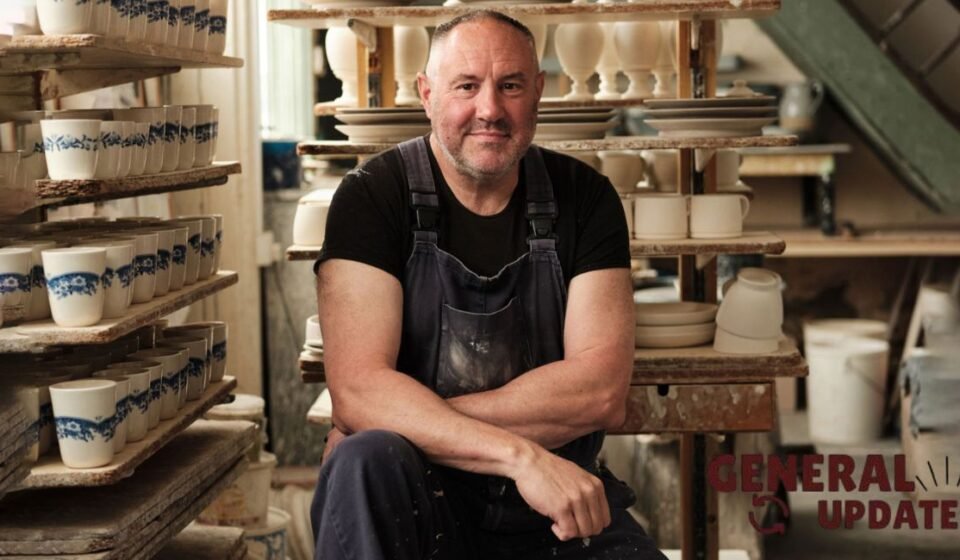

The Unlikely Rise of a British National Treasure
Keith Brymer Jones has become one of Britain’s most unlikely national treasures. The Finchley-born potter and ceramic designer, instantly recognisable for the tears that well up whenever a particularly fine piece of work appears on The Great Pottery Throw Down, has spent more than four decades shaping clay into objects that sit on kitchen tables across the country and far beyond. His journey from a dyslexic schoolboy who found solace in an art classroom to a bestselling designer and television judge is a thoroughly British story of quiet graft, unexpected turns and an unshakeable belief that ordinary things can carry extraordinary feeling.
Early Life and the Discovery of Clay
Born on 3 June 1965 in Finchley, north London, Keith Brymer Jones grew up in a middle-class suburban household. His father was a sporty estate agent and keen tennis player; his mother a domestic cookery teacher whose kitchen filled the house with the scent of cakes and proper home cooking. School, however, was a struggle. Undiagnosed dyslexia left him feeling adrift in the classroom, and the usual academic subjects never clicked. What did click was clay. At the age of eleven he made his first pot – a pottery owl – and the moment the soft material responded to his hands he knew he had found his language. Form, volume and texture made sense in a way words on a page never had. Ballet classes from the age of five until eighteen further sharpened his sense of physical discipline and movement, skills that would later transfer directly to the wheel.
From Punk Stage to Pottery Apprenticeship
After a brief and colourful interlude as the lead singer of a punk band called The Wigs in the early 1980s – complete with Radio 1 sessions and support slots for bands that would later become household names – Keith Brymer Jones returned to the material that had first captured him. At eighteen he placed a determined advertisement in Ceramic Review seeking an apprenticeship. The reply came from Harefield Pottery in London. There he learned the hard way: months of shovelling clay, sweeping floors and making tea before he was allowed near the wheel. The discipline was tough, the hours long, but the foundation it gave him proved invaluable. When the pottery eventually relocated to Scotland he stayed in London, opened his own studio in Highgate and began producing hand-thrown work for some of the most respected names on the British high street.
Building a Career in British Ceramics
Orders arrived from Habitat, Heal’s, Laura Ashley, Monsoon and the Conran Group. At one point he was throwing a thousand pots in a single day and fulfilling commissions of up to 16,000 pieces by hand. The physical stamina required was immense, yet the work brought a deep satisfaction. It was during this period that the idea for what would become his signature Word Range began to form. Drawn to the visual shape of words rather than their meaning – a natural consequence of his dyslexia – he started stamping simple, retro typewriter lettering onto clean white porcelain. Mugs, bowls and plates carrying words such as “love”, “tea” or something considerably more colourful found an immediate audience. The range grew, travelled to more than forty countries and became the foundation of a thriving design business.
The MAKE International Years and the Word Range
In 2008 Keith Brymer Jones joined forces with Dominic Speelman and became Director and Head of Design at MAKE International. A converted bakery in Whitstable on the Kent coast became the new studio. Prototypes were still thrown by hand on the wheel before being developed for production. The collaborative spirit of the company allowed him to work with other designers and illustrators while remaining true to the philosophy that has guided him throughout: create simple, practical pieces that are pleasing to the eye and, above all, make people happy. The Word Range continues to evolve, yet the core idea remains unchanged – honest ceramics for everyday life.
Television Fame and The Great Pottery Throw Down
Television arrived almost by accident. A playful promotional video in which he dressed as Adele and performed a pottery-themed parody of “Rolling in the Deep” went viral and caught the eye of the producers behind The Great British Bake Off. In 2015 The Great Pottery Throw Down launched on BBC Two with Keith Brymer Jones and Kate Malone as expert judges. From the very first episode his readiness to cry when faced with a beautifully realised piece of work set the tone for the series. Audiences responded to the authenticity. When the programme later moved to Channel 4 it retained the same emotional honesty. Contestants still speak of the supportive atmosphere he helps create; viewers still reach for the tissues when he does. The tears are never manufactured. They come from a lifetime spent understanding just how much of a person can be poured into a single vessel of clay.
Autobiography, Recognition and Personal Life
In 2022 he published his autobiography, Boy in a China Shop: Life, Clay and Everything. The book traces the full arc – childhood struggles, the apprenticeship years, the lonely long days in the Highgate studio, the punk interlude, the unexpected television fame – with the same straightforward warmth that characterises his on-screen presence. It sold well and took him on a national tour that connected him with readers who saw their own quiet determination reflected in his story. An honorary graduation from the University of Staffordshire in 2019 further recognised his contribution to British ceramics and his support for the historic Potteries.
Personal life has also found a new chapter. Keith Brymer Jones lives with his partner, the actress Marj Hogarth. Together they bought Capel Salem, a dilapidated chapel in Pwllheli on the Llyn Peninsula in North Wales, and set about restoring it as both home and working studio. Their progress has been documented in the Channel 4 series Our Welsh Chapel Dream. The project is typically ambitious and thoroughly practical – a place where clay can be thrown, where apprentices might one day train, and where the couple can put down roots beside the sea. He has a son, Ned, from a previous marriage, and speaks of family with the same openness he brings to his craft.
Also read: Princess Andre Net Worth: The Rising Reality Star Building Her Own Fortune
A Lasting Contribution to Everyday British Life
What sets Keith Brymer Jones apart is not simply technical skill or commercial success. It is the consistent belief that pottery belongs in ordinary lives. A well-thrown mug is not a precious object to be locked away; it is something to be used, washed, and used again. The tactile pleasure of lifting a cup to the lips, the quiet satisfaction of a bowl that sits steadily on the table – these are the everyday moments he designs for. In an age of disposable goods his work quietly insists on permanence and care.
British ceramics have a long and proud history, from the industrial powerhouses of Staffordshire to the studio potters who kept hand skills alive through leaner decades. Keith Brymer Jones stands firmly in that tradition while remaining thoroughly contemporary. His designs sit comfortably in modern kitchens yet carry the weight of decades of practice. His television presence has introduced a new generation to the possibilities of clay, showing that pottery is not an exclusive or rarefied pursuit but a craft open to anyone willing to get their hands dirty.
The workshop in Whitstable, the restored Welsh chapel, the endless series of mugs carrying single words that somehow manage to mean more than they should – all of it points back to that first owl made by an eleven-year-old who discovered he could speak through clay. Keith Brymer Jones has never stopped listening to what the material tells him. In return, a large part of Britain has learned to listen too, often with a lump in the throat and a smile at the same time.
Frequently Asked Questions
Who is Keith Brymer Jones?
Keith Brymer Jones is a British potter, ceramic designer and long-serving judge on Channel 4’s The Great Pottery Throw Down.
What is Keith Brymer Jones best known for?
He is best known for his emotional judging style on The Great Pottery Throw Down and for the popular Word Range of homeware featuring retro typewriter lettering.
Where does Keith Brymer Jones live?
He and his partner Marj Hogarth are restoring Capel Salem, a former chapel in Pwllheli, North Wales, which serves as both home and studio.
Does Keith Brymer Jones have a book?
Yes, his autobiography Boy in a China Shop: Life, Clay and Everything was published in 2022.
Is Keith Brymer Jones married?
He is in a long-term relationship with actress Marj Hogarth; the couple appear together in the Channel 4 series Our Welsh Chapel Dream.
Why does Keith Brymer Jones cry on The Great Pottery Throw Down?
His tears are a genuine response to the skill, vulnerability and personal stories expressed through the contestants’ ceramic work.



[…] Keith Brymer Jones: The Potter Who Made Britain Cry Over Clay […]